Showing posts with label teaching. Show all posts

Saturday, February 18, 2012

Second Life--Moving and Viewing

So, I just spent a few minutes walking around Eagle Island and have noticed some really exciting features of Second Life. I am really beginning to see how it can fit into an educational setting. I really like that SL allows it's citizens to fly. The first thing I did was fly to the top of a nearby mountain to see the surrounding landscape:


After flying around a bit, a video started playing. I didn't intentionally start the video, so I had no idea where I could find it to turn it off. So, off I went, on an epic adventure to end the chicken reproduction system video. I looked at the nearby videos and in the lab, but couldn't find it.

Next, I flew up and out to find a section of the island to which I did not have access. After flying in circles for a few moments, I found an outdoor classroom with a huge screen at its center. There, I found the chicken video and turned it off. Next, I flew to the beach for some much needed relaxation after the stress of flying around to find the chicken video (SL can be stressful :-p). So I laid down in the hammock. Brilliant!

Next, I roamed around to several other "boothes" that were set up that had some interesting information linked to them. I ended my time on Eagle Island this afternoon by watching the sunset. Sitting on...a goat.
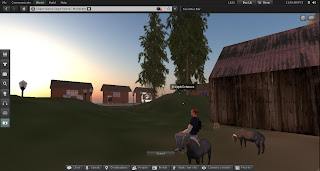
As I was walking (running, flying) through Eagle Island, my creative teacher-juices began to flow. I began to think of the various destinations that have been created to mimic real life (at times, historical) places. Students would be able to access these places to get a 3D view of the particular region or city we are studying. Also, I realized people can create museums, or islands of specific events in history. For example, it wouldn't surprise me if someone has created an island for WWII or the Holocaust to be more specific. The potential to create these and other such "displays" makes SL much more intriguing and usable in the classroom. The more I experience, the more likely I am to actually try this with my students. I'm excited to continue to explore the SL world and its potential to aid in instruction.

Thursday, January 12, 2012

Gaming to Learn

Can gaming actually help us learn? This is exactly what Tim Chatfield argues in the following Ted Talk, and it makes a lot of sense. First of all, gaming has proliferated in the past twenty years. It is a multi-billion dollar industry. Tim argues that this is at least partially due to the rewards individuals (or groups) reap while engaging each other and the environment in a virtual world. Game designers can measure billions of data points while the game, and then calibrate the game--that is, balancing effort and reward--to keep players engaged.

Tim mentions 7 ways games reward the brain:
  1. Experience bars--players can see their experience level and compare it to an end goal. They see themselves progress and take ownership of their attempting to reach the goal.
  2. Multiple long and short term goals--lots of different tasks to give people a variety of options to choose from
  3. Rewards for effort--everything done in the game reaps some kind of benefit. For example, if you kill a monster, you get at least a little bit of in-game currency.
  4. Rapid, frequent, clear feedback--the player is often reminded of how she is doing and whether she is on the right track
  5. An element of uncertainty--the gamer always has a chance for something really awesome to happen--they will get an extra, unexpected reward, for example.
  6. Windows of enhanced attention--by measuring dopamine levels in the brain, we can predict windows of time when learning is taking place at an enhanced level.
  7. Other people--"the biggest neurological turn on" is interacting with other people.
If we could somehow apply these same ideas in an education setting, I think the benefits would be huge. I envision a class in which students are engaged on an individual basis, each one learning at his own pace. Each achieving at a level appropriate to him. Some students zoom ahead of others at a blinding pace, others take the tortoise's approach, everyone learns. This is differentiating instruction at its finest.